
Texas headquarters. Healthcare technology installation across Central and South Texas, with nationwide rollout capability across multiple facilities.
ASAP Computer Services installs the physical technology layer behind connected healthcare environments: telehealth and virtual care hardware, patient entertainment and interactive engagement systems, permanently mounted audio visual equipment, nurse call and pillow speaker cabling, paging, clocks, digital signage, and the Cat6, Cat6A, fiber, and PoE infrastructure connecting it all.
Serving San Antonio, Austin, New Braunfels, Seguin, Boerne, San Marcos, Corpus Christi, Laredo, Victoria, the Texas Hill Country, Central Texas, and South Texas, plus nationwide healthcare rollouts for operators with multiple sites and technology manufacturers.
♫ Deep in the Heart of Texas ♬, headquartered in San Antonio.
Call: (210) 497-1424
RCDD#356281 | TXDPS#B28590101, TXDPS#B28659001 | TX LIC#157472401 | TX LIC#157472402 | TX LIC#157472403
Healthcare Technology Infrastructure, Installed from the Physical Layer Up
ASAP Computer Services provides healthcare technology installation services and is based in San Antonio. We install and document the fixed hardware, mounting systems, pathways, network cabling, fiber, Power over Ethernet infrastructure, and equipment room connections required by telehealth, patient engagement, entertainment, clinical communication, and healthcare AV systems.
Some manufacturers and program managers describe this role as a healthcare technology deployment company or healthcare TDC. We use the more direct description: we are the field installation and infrastructure installation company. We coordinate with healthcare owners, project managers, clinical engineering, IT departments, AV consultants, telehealth platform providers, patient engagement vendors, nurse call vendors, and equipment manufacturers so each party’s system connects to a documented physical layer.
We install the technology in the room and the infrastructure behind the wall. We do not provide medical care, telemedicine services, EHR software development, or API integration unless those services are specifically provided by another contracted technology partner.
For Healthcare IT, Facilities, Clinical Engineering, and Operations Teams
If you work for a hospital, clinic, healthcare system, emergency room operator, imaging group, surgical center, or medical office portfolio and you are looking for a vendor that can install the room technology and the infrastructure behind it, we can help.
You should not have to manage one company for the display, another for the network drop, another for the headwall arm, another for the paging cable, and a fifth company to explain why the telehealth camera will not power up. We bring the physical installation, low voltage infrastructure, testing, labeling, and closeout into one accountable scope.
- One accountable physical technology company. Telehealth endpoints, patient entertainment, fixed AV, paging, clocks, signage, nurse call support cabling, racks, copper, fiber, and PoE infrastructure can be coordinated through one installation team.
- Infrastructure first. We verify pathways, backing, mounting conditions, rack space, network drops, fiber, PoE capacity, and equipment room connections before a device problem becomes an opening day problem.
- Coordination with your technology vendors. We work with healthcare IT, clinical engineering, patient engagement vendors, telehealth platform providers, nurse call vendors, AV consultants, and equipment manufacturers without claiming the software scope that belongs to them.
- Occupied facility experience. Work is planned around patient care, unit schedules, infection control requirements, credentialing, restricted access, daily cleanup, and the building remaining operational.
- Documentation your teams can use. Device locations, serial information when required, cable labels, test results, photographs, punch status, and closeout records are organized for facilities, IT, clinical engineering, accounting, and future service vendors.
- Texas access with national reach. Our headquarters is in San Antonio. Texas owners know where we are, and operators with facilities outside Texas keep the same accountable contact for standardized rollout work.
Send us the drawings, room list, equipment list, facility locations, and schedule. We will identify the physical installation scope, infrastructure dependencies, and information needed for a proposal. Call (210) 497-1424.
Texas Healthcare AV and Telehealth Installation
Our primary regional service area is anchored in San Antonio and extends through Austin, New Braunfels, Seguin, Boerne, San Marcos, Corpus Christi, Laredo, Victoria, the Texas Hill Country, Central Texas, and South Texas. We support hospitals, freestanding emergency rooms, micro hospitals, surgical centers, imaging centers, dialysis facilities, behavioral health facilities, urgent care groups, medical office buildings, and healthcare real estate portfolios.
For programs extending beyond Texas, the same San Antonio teams travel and remain the accountable point of contact.
Telehealth, Virtual Care, and Remote Patient Monitoring Installation
Telehealth integration begins with reliable physical infrastructure. We install the permanently mounted equipment and network layer supporting virtual visits, virtual nursing, virtual sitting, remote patient monitoring, specialist consultation, and other connected care workflows.
- Clinical hardware deployment: Cameras, displays, microphones, speakers, wall stations, carts when included in the project scope, device brackets, and mounting hardware specified by the manufacturer.
- Network and PoE infrastructure: Cat6, Cat6A, fiber, PoE and PoE++ pathways, patching, labeling, testing, and equipment room coordination.
- Room readiness: Mounting heights, viewing angles, camera fields of view, microphone placement, backing and substrate verification, pathway capacity, and service clearances.
- Coordination across systems: Telehealth hardware coordinated with patient TVs, interactive patient engagement, nurse call, pillow speakers, paging, and the facility network.
- Deployment documentation: Device locations, make and model information, serial capture when required, cable identification, test results, photographs, and closeout records organized by room or by facility.
What Telehealth Integration Means
Telehealth integration means installing the clinical endpoints and the low voltage infrastructure that lets the telehealth platform operate reliably in the room. The telehealth platform vendor, healthcare IT team, EHR vendor, or software integrator normally handles application configuration, identity, interfaces, APIs, FHIR workflows, cybersecurity policy, and clinical workflow design. We coordinate with those parties and provide a tested physical handoff rather than overstating our role as a software or hospital information systems integrator. These are proprietary systems and we do not expect visibility into those areas due to security concenrs.
Patient Entertainment, Interactive Engagement, and Fixed AV
Patient entertainment and telehealth increasingly share the same wall, headwall, network, and support teams. Treating them as unrelated packages creates duplicated pathways and unclear responsibility. We install the fixed AV and low voltage components as one coordinated room technology scope.
Patient Room TVs and Headwall Arms
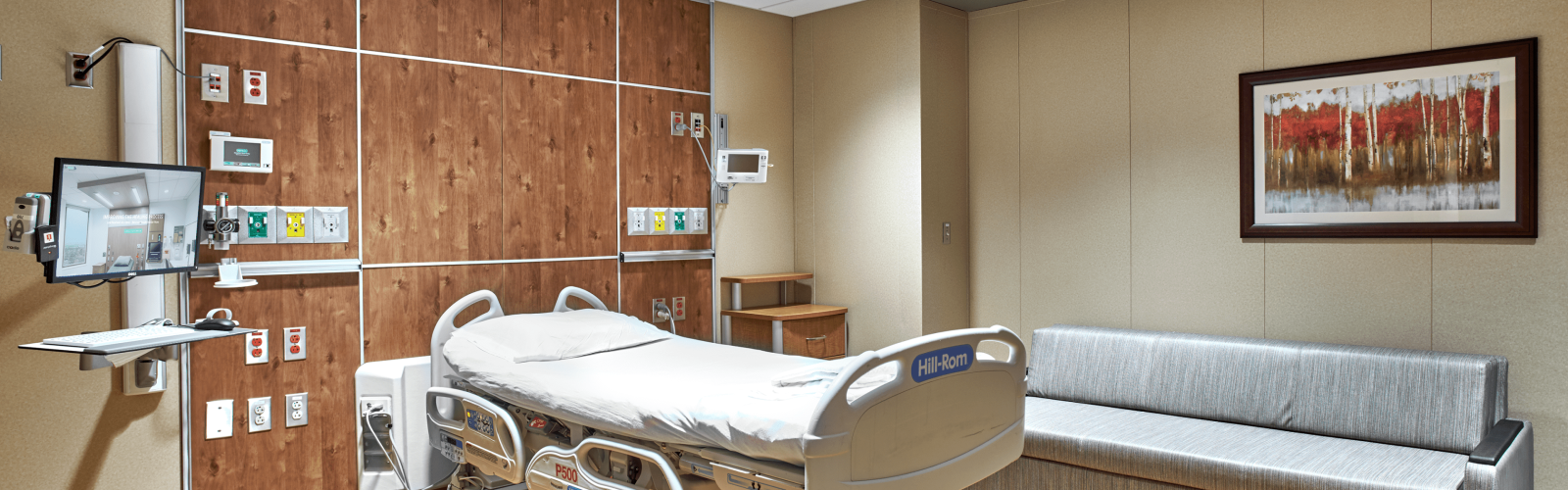
Healthcare grade patient TV installation on articulating headwall arms, fixed wall mounts, and ceiling mounts, installed to the specified mounting height, reach, cleaning clearance, and actual substrate behind the finished wall. We coordinate with patient engagement and interactive patient entertainment platform vendors and document the installed room configuration.
Interactive Patient Engagement and Entertainment
Displays, bedside interfaces, media endpoints, network connections, pillow speaker coordination, and related low voltage work supporting patient education, entertainment, communication, and interactive engagement platforms.
Nurse Call and Pillow Speaker Cabling
Low voltage cabling and device rough in supporting nurse call systems, pillow speakers, dome lights, and staff stations, coordinated with the nurse call platform vendor and integrated cleanly with the patient television and headwall installation.
Healthcare Audio Visual and Clinical Communication Systems
Our healthcare AV work covers permanently installed systems that mount to a wall or headwall, hang from a ceiling, sit in a rack, or connect through a structured pathway.
Overhead Paging and Code Communication
Ceiling speaker installation, zoned overhead paging, code communication support, background music, and sound masking for registration, consult, administration, and areas adjacent to patient care, installed and tested to the project requirements.
Synchronized Clock Systems
Wired, wireless, and PoE or NTP referenced clock installation for operating rooms, emergency departments, medication rooms, nurse stations, imaging, administration, and other locations requiring consistent time display.
Digital Signage and Wayfinding
Waiting room displays, patient information boards, wayfinding signage, menu displays, and staff communication screens, including mounting, network connectivity, labeling, and coordination with the facility’s content and IT teams.
Conference, Training, and Clinical Collaboration Rooms
Displays, cameras, microphones, speakers, control hardware, and network connections for healthcare administration, physician lounges, education, simulation, boardrooms, and clinical collaboration spaces.
AV Racks and Head End Rooms
Rack buildouts, equipment mounting, cable dressing, labeling, patching, testing, and closeout documentation organized so facilities, clinical engineering, IT, and future service vendors can understand the installation.
AV Cabling and Low Voltage Infrastructure
Most AV problems are cabling problems. A patient TV that drops signal, a telehealth camera that will not power up, a paging zone that hums, or a signage player that keeps losing the network usually traces back to the physical layer, not the equipment.
Because our core business is structured cabling and network infrastructure, AV cabling is not a side skill we picked up. We install the Cat6 and Cat6A drops feeding displays, cameras, clocks, patient engagement, and telehealth endpoints; the fiber backbone between equipment rooms; HDMI and HDBaseT runs; speaker and paging cable; nurse call and pillow speaker cabling; coax where it is still required; and the PoE infrastructure powering an increasing share of clinical technology. Every run is terminated, labeled at both ends, tested on calibrated equipment, and documented.
That matters most on healthcare projects where the AV integrator, the IT department, the nurse call vendor, and the project managers all point at each other when something does not work at the headwall. Documented, tested cabling ends that conversation.
Related services: Commercial security camera installation and commercial access control installation. In healthcare facilities, AV, cameras, and access control often share pathways, equipment rooms, credentialing requirements, and closeout expectations. One licensed company handling the physical installation reduces the coordination gaps between them.
Retrofit Work in Occupied Hospitals and Clinics
Installing telehealth, patient AV, or network infrastructure in an operating healthcare facility requires a different workflow than ordinary commercial construction. Our crews plan around the building remaining open and patient care continuing.
- Infection control coordination, containment, clean work practices, and access procedures specific to the facility
- Vendor credentialing, badging, background requirements, escorts, and scheduling for restricted areas
- Phased, after hours, and room by room scheduling around patient care, procedures, census, and unit operations
- Coordination with facilities, clinical engineering, nursing leadership, IT, project managers, and technology vendors
- Daily cleanup, dust control, ceiling restoration, labeling, testing, and progress documentation
Whether the project is one imaging suite, a telehealth upgrade across multiple departments, or a patient room technology refresh across an occupied tower, the installation plan starts with protecting facility operations.
What Fixed AV Means on a Healthcare Project
In construction documents and owner budgets, fixed AV refers to permanently installed audiovisual equipment and infrastructure, displays, mounts, headwall arms, speakers, paging, clocks, signage, racks, and the cabling behind them, as distinct from portable or loose equipment. The scope commonly appears in Division 27 documentation and may be treated as a capital asset by the healthcare owner.
Our closeout documentation can support facility records and fixed asset tracking with equipment locations, make and model information, serials when required, mounting details, cable identification, test results, photographs, and as built information.
Texas Headquarters with Nationwide Healthcare Rollout Capability
Texas is our home market. Nationwide work is available for standardized deployments across multiple facilities, portfolio programs, and manufacturer installation partnerships where consistent execution matters more than hiring unrelated local labor in every city.
We have completed a healthcare fixed AV program spanning approximately 90 facilities in 18 states. That experience shapes how we run both Texas and national programs:
- One installation standard: Consistent device placement, mounting, cable, labeling, testing, and closeout requirements at every site.
- One accountable contact: Corporate facilities, construction, IT, or the manufacturer works through a responsible program lead rather than a rotating dispatch network.
- Deployment based on a prototype: Approved drawings, room standards, bills of material, and field checklists converted into repeatable installations.
- Documentation for each facility: Equipment records for each site, serials, photographs, test results, punch status, and closeout packages for remote review.
- Planned mobilization: Travel, lodging, credentialing, badging, access, shipping, and site readiness addressed before crews arrive.
- Schedule visibility: Site sequencing, readiness tracking, exception reporting, and escalation tied to openings, surveys, and owner milestones.
Nationwide availability is a program capability, not an on demand rate card dispatch service.
For General Contractors and Construction Managers
If a healthcare owner or design team has directed you to us for the fixed AV, telehealth infrastructure, or low voltage scope, here is what you need to know to move on with your day.
- Licensed and insured. Texas Department of Public Safety Private Security Program licensed for the security related portions of low voltage work, with license numbers published above. Certificates of insurance are issued to your project requirements without a two week delay.
- Prequalification ready. Active profiles with ISNetworld, Avetta, and SAP Ariba. JHAs and safety documentation specific to the site are provided as required.
- OSHA trained crews built for healthcare jobsites. OSHA 30 leadership, OSHA trained field staff, and crews accustomed to infection control protocols, occupied facility phasing, restricted access, and environment of care expectations.
- Submittals and closeout that pass. Product data, coordination drawings where required, test documentation, as built records, and O and M material formatted for your closeout package, not a shoebox of receipts at final punch.
- Schedule coordination. Rough in through trim with the other trades, coordination meetings when the project warrants them, and conflicts flagged before they cost you a ceiling or a survey date.
- RCDD led. Technical questions get answered by a BICSI Registered Communications Distribution Designer, not routed to a voicemail box.
Documentation, references, license verification, and prequalification information are available on request. Call (210) 497-1424.
For Equipment Manufacturers and Technology Vendors
If you sell patient engagement platforms, healthcare grade televisions, headwall systems, telehealth and virtual care technology, digital signage, remote patient monitoring equipment, or clinical communication products into healthcare accounts, installation is probably the least profitable and highest liability part of your delivery. Ladders, labor, travel, credentialing, and warranty callbacks are not what your company is built to do. One bad install at a flagship hospital can cost more than the hardware margin on the entire order.
We install other companies’ hardware as our primary business, and we structure the relationship so it never costs you the account:
- Your account stays yours. We install. We do not sell competing hardware into your customers. No channel conflict, stated up front rather than discovered later.
- Direct client billing available. Many manufacturers prefer that we invoice the healthcare client directly for installation. You keep the hardware revenue and the customer relationship. We carry the labor, warranty responsibility for our work, and installation liability. We are equally comfortable working under your MSA and your brand standards when that fits better.
- Installed to your standard. Mounting specifications, cable dressing, commissioning steps, field checklists, and closeout format follow your documentation, so your product is represented the way you intend at every facility.
- Single crew accountability. The technicians who start your program finish it. Your rollout is not handed to whichever body is available in a given market that week.
- Healthcare credentialed crews. Vendor credentialing, badging, background checks, infection control practices, and restricted area procedures are already part of how we work. Your client does not have to teach us their building.
- Documented installations. Photographs, serial capture, test results, punch status, and closeout for each facility so your support team is not troubleshooting blind six months later.
We are a specialized installation company, not a volume dispatch network, and we do not bid rate card labor programs. If you are looking for the cheapest available hands in a given zip code, we are the wrong call. If your brand reputation depends on the installation being right in a patient room, start a conversation: (210) 497-1424.
For Architects, Engineers and AV Consultants
If you write Division 27 41 16 for healthcare projects or design AV and connected care technology into clinical space, we are the company who has to build what you draw. We would rather help you get it right in design than field fix it in construction.
- Design assist and constructability review. Headwall substrate and arm anchoring, pathway capacity, device and mounting heights in clinical rooms, PoE budgets for telehealth and clock systems, camera fields of view, service clearances, and equipment room sizing reviewed against actual field conditions before drawings go out.
- Budget input for early estimates. Realistic per room and per facility installation numbers for patient room AV, telehealth, paging, clocks, and signage when you need a schematic design figure, instead of a placeholder that blows up at bid.
- Standards competence. BICSI RCDD led, familiar with TIA and EIA cabling standards, NEC plenum and pathway requirements, ADA mounting considerations, PoE planning, and the practical realities of specifying technology into patient environments.
- Basis of design and approved installer support. Documentation, credentials, and program references for owner standards and approved vendor lists, including prototype driven healthcare operators standardizing across a portfolio.
We are also building out reference material on AV infrastructure for telehealth, virtual nursing, and AI assisted patient monitoring, an area where design standards are still forming and much of the published guidance has not caught up. If that is useful to your practice, get in touch.
For Owner’s Representatives and Program Managers
Owner’s representatives, healthcare development partners, and program management firms carry the risk of every vendor recommendation they make. A specialized company who handles their own scope cleanly is worth more than a general labor pool that has to be managed.
- We contract directly with healthcare owners and operators. Referred scopes are engaged directly with your client, so you get the credit for the recommendation without carrying our paper or our liability.
- Specialized scope only. Fixed AV, telehealth hardware deployment, structured cabling, cameras, and access control. We are not a general labor resource, and we do not participate in pooled vendor networks or volume dispatch programs.
- Visibility preserved. You referred it, so you stay informed. Progress reporting, closeout copies, and issue escalation come to you as well as to the client for as long as you want them.
- Vetted before you ask. Licensed, insured, prequalified, RCDD led, healthcare credentialed, and operating since 1999. The due diligence answers are ready before your client asks for them. References from JLL and other firms are available upon request.
Scope Boundaries
What we are not and what we do not provide.
- We are not a telemedicine provider. We do not provide clinical care, diagnose patients, or operate a virtual care service.
- We are not an EHR or healthcare software developer. We coordinate the installed hardware and network handoff with platform and software teams. We do not claim API, FHIR, or EHR integration unless separately contracted through a qualified technology partner.
- We are not a residential AV installer. No home theaters or residential television mounting. Healthcare, commercial, and institutional facilities only.
- We are not an event or rental staging company. Our work is permanently installed technology and infrastructure, not temporary production equipment.
- We do not bid anonymous rate card labor programs. Projects are scoped, supervised, tested, and documented. Nationwide work is structured as a program rather than a lowest cost dispatch network.
- We do not substitute gadget grade equipment for specified clinical hardware. Equipment suitability, mounting, cleaning requirements, duty cycle, and manufacturer instructions are addressed before installation.
Healthcare Technology Installation Service Area
Primary Texas markets: San Antonio, Austin, New Braunfels, Seguin, Boerne, San Marcos, Corpus Christi, Laredo, Victoria, the Texas Hill Country, Central Texas, and South Texas.
Nationwide option: Healthcare rollouts across multiple facilities, portfolio deployments, prototype programs, and installation partnerships for telehealth, patient engagement, medical technology, and fixed AV manufacturers across the United States.
Healthcare AV and Telehealth Installation FAQ
Can one company install both telehealth and patient entertainment systems?
Yes. Telehealth, patient entertainment, interactive engagement, nurse call interfaces, pillow speakers, and network infrastructure often meet at the same patient room wall or headwall. We can coordinate the mounting, pathways, cabling, hardware installation, testing, and documentation as one physical technology scope while the respective platform vendors handle software and application configuration.
Are you a telehealth software or EHR integrator?
Our primary role is telehealth hardware deployment and infrastructure installation. We install cameras, displays, microphones, wall stations, mounts, Cat6A, fiber, PoE, racks, and related physical systems, then coordinate the tested handoff with the healthcare IT, platform, EHR, or software integration team.
Do you install remote patient monitoring and virtual nursing hardware?
Yes, when the project scope includes the physical devices and supporting infrastructure. Work may include mounting, network drops, PoE capacity, equipment room connections, labeling, testing, room documentation, and coordination with the monitoring platform vendor.
What Texas markets do you serve?
We are headquartered in San Antonio and serve healthcare projects in San Antonio, Austin, New Braunfels, Seguin, Boerne, San Marcos, Corpus Christi, Laredo, Victoria, the Texas Hill Country, Central Texas, and South Texas.
Can you handle projects at two or more healthcare facilities at the same time?
Yes. Work across multiple sites is managed as a program with prototype standards, site readiness tracking, crew scheduling, consistent documentation, and one accountable point of contact. The project plan determines whether sites run sequentially or concurrently.
Can you handle a nationwide healthcare technology rollout?
Yes. Nationwide capability is available for standardized rollouts across multiple facilities, healthcare portfolio programs, and manufacturer installation partnerships. We have completed a fixed AV program spanning approximately 90 facilities in 18 states.
Can you work in an occupied hospital or clinic?
Yes. Retrofit work in occupied facilities is regular work for us and includes infection control coordination specific to the facility, credentialing, phased and after hours scheduling, daily cleanup, and communication with facilities, clinical engineering, nursing, IT, and the project team.
What does a healthcare AV installer actually do?
We install permanently mounted patient room televisions and headwall arms, telehealth endpoints, paging, synchronized clocks, digital signage, conference and training room systems, racks, nurse call and pillow speaker cabling, plus the Cat6, Cat6A, fiber, and PoE infrastructure behind those systems.
What information helps you price a healthcare technology installation?
Useful starting information includes drawings or floor plans, room and site counts, device locations, equipment lists, manufacturer requirements, headwall or mounting details, network closet information, construction or phasing schedules, site access requirements, and the desired testing and closeout format. For a rollout, a prototype drawing set and site list are enough to begin a scope review.
Request Healthcare Technology Installation Pricing and Availability
Tell us the facility type, Texas market or national site list, room count, technology being installed, construction or retrofit schedule, and the documentation required at turnover. We will identify the physical installation scope, infrastructure dependencies, mobilization requirements, and the information needed for a proposal.
Call: (210) 497-1424
