

By Courtney Pelzel, BICSI RCDD #356281
July 29, 2026. Fiber optic cost per ft San Antonio
How much does fiber optic installation in San Antonio cost $1/ft? The honest answer is the same one we give for structured cabling: it depends on a short list of factors that most companies will not explain to you, and any company that quotes a fiber job without seeing the pathway is guessing with your money. This page walks through what actually drives fiber optic installation cost, from strand count and jacket type to splicing, testing, and the documentation package at the end, so you can read a fiber quote like someone who has pulled the cable. When you are ready for a real number, contact us or call 210-497-1424 and we will look at the actual job. Typical OSP underground placement in existing pathways with out rodding and roping is $1.30-$2.00. Aerial rates vary but bet on mobilization minimum of at least $300 average for a bucket truck to hot shot, $500 and up for the truck roll, fiber optic cost per ft in san antonio for aerial placement averages much less, $1 or less but minimum linear footages of 10k or more are factored in and adders such as lashing, case placement etc. will be supplementary charges from any company you choose for aerial fiber work. As a side not we do not do aerial placement and if you are looking for an Aerial company we can recommend a couple prime telecommunications companies in our market..
Jump to…
- Why Buildings Need Fiber
- The Small Jobs We Can Finish in a Day
- What Drives Fiber Optic Installation Cost
- Our Splicing Capability
- Testing, and the Paperwork That Proves It
- Outside Plant, Briefly
- Brownfield Retrofit Is Our Sweet Spot
- Big Projects and the Project Speedometer
- Reading a Cheap Fiber Bid
- Design First: What the RCDD Stamp Means
- Where We Work
- Fiber Cost FAQ
Why Buildings Need Fiber
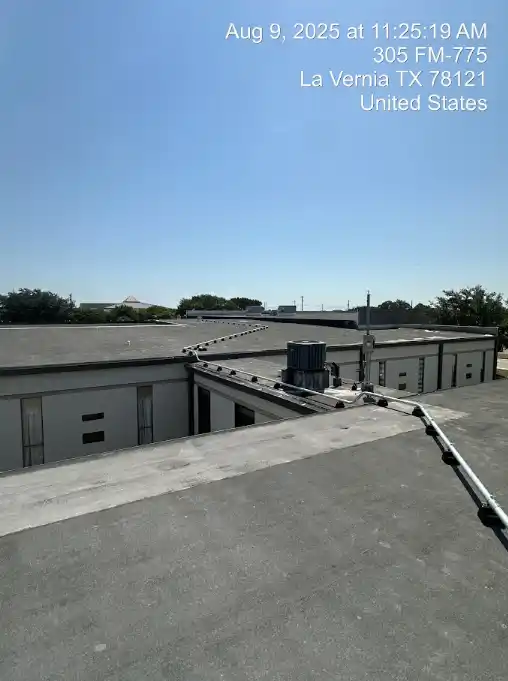
Copper has a hard limit. Cat6 runs out at 328 feet, 100 meters, and that is that. In a large office building, a warehouse, or a smaller healthcare facility, there are almost always rooms that sit past that limit, or separate parts of the building that need to be connected, and that is where fiber earns its keep. Distance is simply not fiber’s problem.
So a very common project for us looks like this: a business needs to bring the network to a far room, a second suite, a shop floor, or another wing. We place the fiber cable, prep it and dress it, manage it, terminate it, and land it in a panel close to the switch. From there your Layer 2, 3, and 4 equipment takes over, and if you want help on that side too, our network support team lives at those layers.
The Small Jobs We Can Finish in a Day
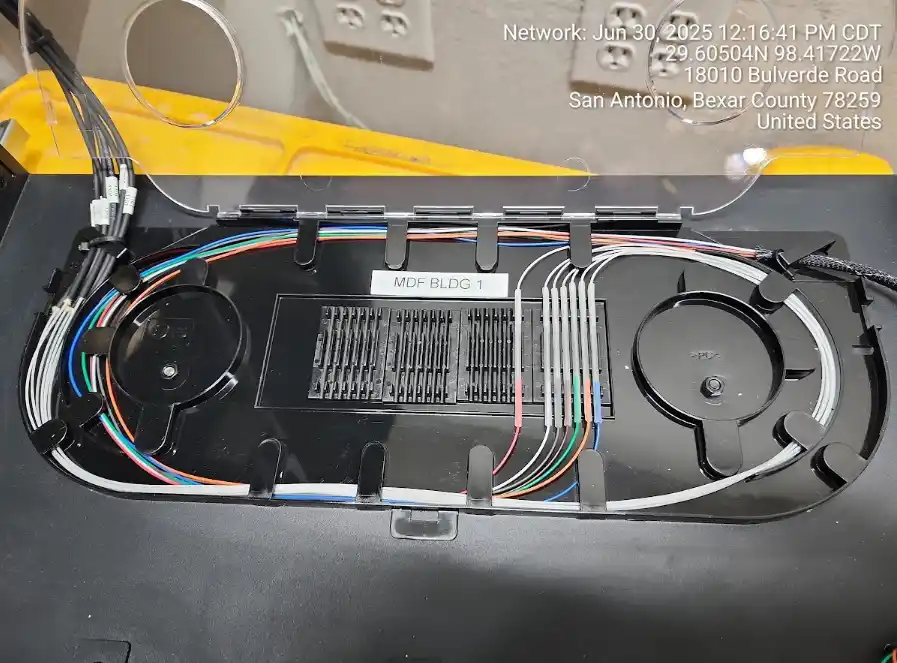
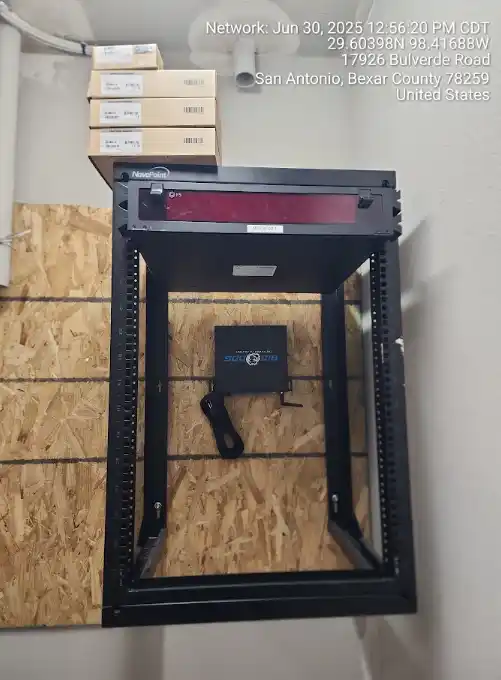
Not every fiber job is a campus. Sometimes it is a simple demarc extension, or a single run between two rooms. These are fun, straightforward, and we typically complete them within a day. The cost on smaller projects like these is easier to estimate and quantify, because the variables are fewer and we can see most of them standing in the building.
We genuinely enjoy these jobs, face to face with the project owner who hired us.
What Drives Fiber Optic Installation Cost
Here is the list a quote never explains. Every one of these moves the number:
- Strand count. The quantity of fiber strands inside the cable is a big driver of the cost of the fiber itself. A 144 count cable is a different purchase than a 12 count, and sizing the count right, with headroom for growth, is a design decision, not a guess.
- Jacket and construction. A 144 count MC armored fiber costs quite a bit more than a 144 count loose tube. Armor buys protection; loose tube buys economy. Where the cable lives decides which one you actually need.
- Singlemode or multimode. OS2 singlemode for distance and backbone, OM3 and newer multimode inside buildings and on ISP work, and on utility, energy, and oilfield projects we still frequently run into OM1, the oldest multimode fiber still in service. We splice all of it.
- Connectors and termination method. SC, LC duplex, APC, UPC, the connector type and polish matter, and so does how the ends get finished: fusion spliced pigtails on trays, or field mechanical splices our crew can complete in under a minute. Connector count times termination method is real money.
- The SFP light budget. Something I bring up early in design: the optics on each end have to match the link. SFPs look the same in the hand and perform quite differently case to case. Matching the light budget to the distance and fiber type up front prevents the most annoying kind of turn-up failure.
- Pathway condition. Is there an existing pathway, or are we building one? We look for existing conduit where we can, but two pipes that look the same on both ends do not always connect to each other. We read the footage tick marks on cable jackets to make well educated guesses, and a lot of times we simply have to rod and rope the conduit to know the truth. Finding out is part of the job; guessing is how change orders happen.
- Testing tier. Basic light level testing is one thing; bidirectional OTDR tracing with merged results is another. What the project requires, and what your stakeholders will demand as proof, is a line item.
- The documentation package. Method of procedure, splice report, subscriber assignment map, and the as-built. Construction managers, property owners, and every stakeholder in between rely on these, and the administrative time to produce them properly is a genuine part of the cost. It is also the part the cheap bid quietly deletes.
- Project location and mobilization. Fiber installation is project work, and distance affects the cost of getting technicians, fusion splicers, OTDR equipment, materials, trailers, and other required equipment to the site. A small one-day project close to San Antonio has a different mobilization profile than a multi-day fiber project in Central Texas, South Texas, or the Texas Hill Country. On larger projects, those travel costs are spread across more footage, strands, splices, buildings, or days of work.
For that reason, project location belongs in a real fiber estimate. We quote mobilization and travel requirements up front rather than disguising them inside an arbitrary per-foot rate.
A note on per-foot pricing, because you will see it on fiber quotes: for the fiber cable itself, per-foot pricing is very common, and strand count and jacket type greatly impact that per-foot number. We document placed footages by photographing the footage tick marks printed on the jacket, so the quantities you are billed for are verified, not estimated. But the cable is only one line of an installed job. Pathway, splicing, testing, and documentation are the rest, which is why a per-foot number alone never equals a project price. For the same reasoning on the copper side, see our structured cabling cost guide.
Our Splicing Capability
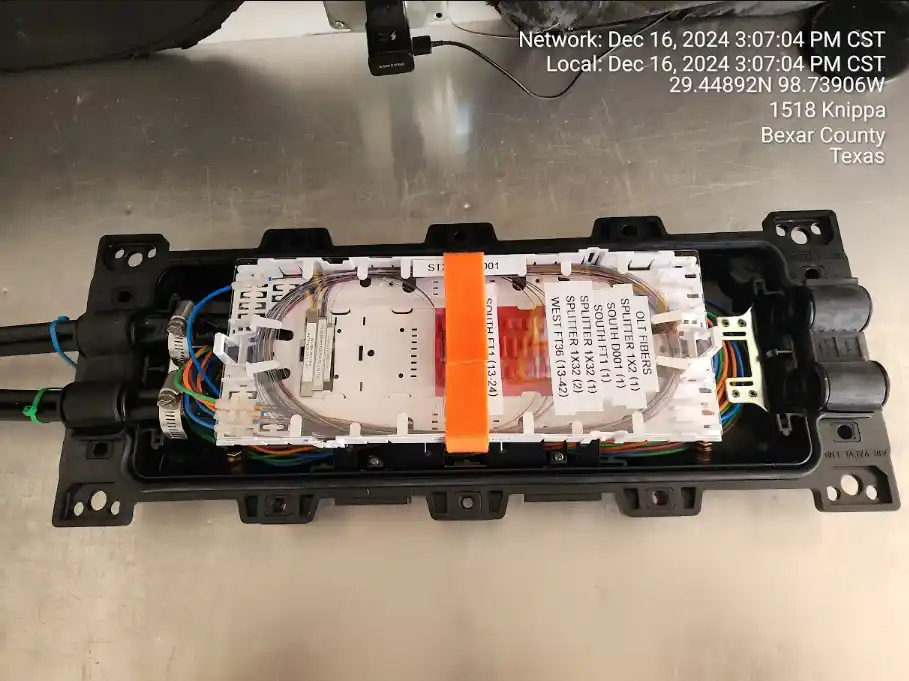
Regardless of placement and termination, we have a very skilled splicing crew. They splice ribbon and single fiber, singlemode and multimode, on Fujikura fusion splicers, equipment that is extremely expensive and worth every penny. We splice onto any connector type with pigtails, trays included, and when the situation calls for it our crew can complete a field mechanical splice in under thirty seconds to a minute.
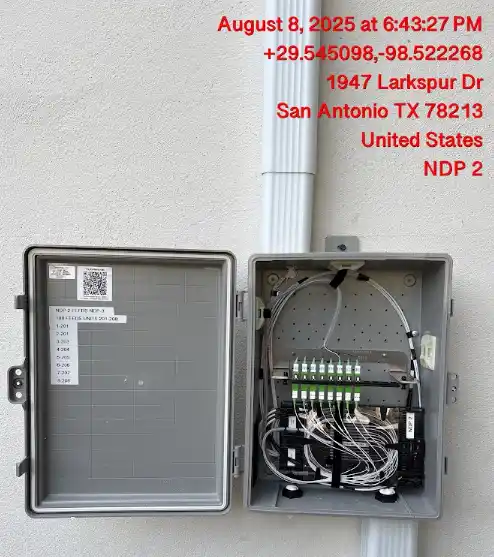
We also run splicing trailers, so field splices happen in clean, controlled conditions instead of on a tailgate in the wind. Splicing is its own trade within the trade, and it is one of the reasons ISPs GCs and B2Bs bring us in. If splicing is the whole job, we have dedicated pages for fiber optic splicing in San Antonio and fiber splicing across Texas.
Testing, and the Paperwork That Proves It
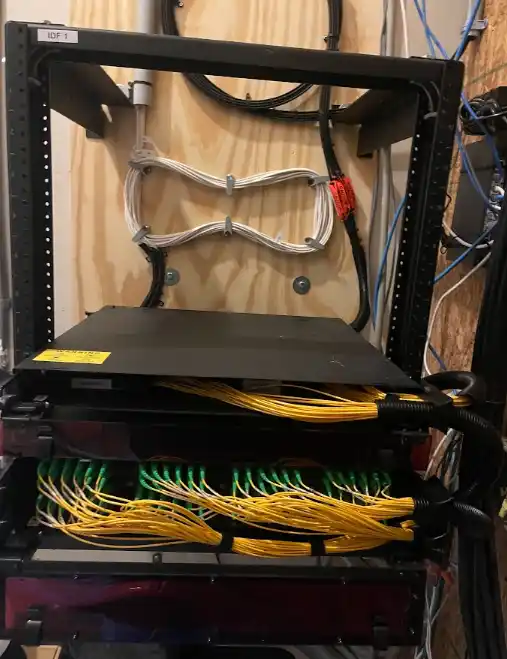
After the splicing is completed, the testing begins, and this is where a professional fiber job separates itself. For ISP work we run bidirectional traces that are then merged into files, and we hand over a method of procedure, a splice report, and a subscriber assignment map along with the as-built. The as-built matters enormously to construction managers and property owners, because it is the document the next company, or your own team, will live by for the next twenty years.
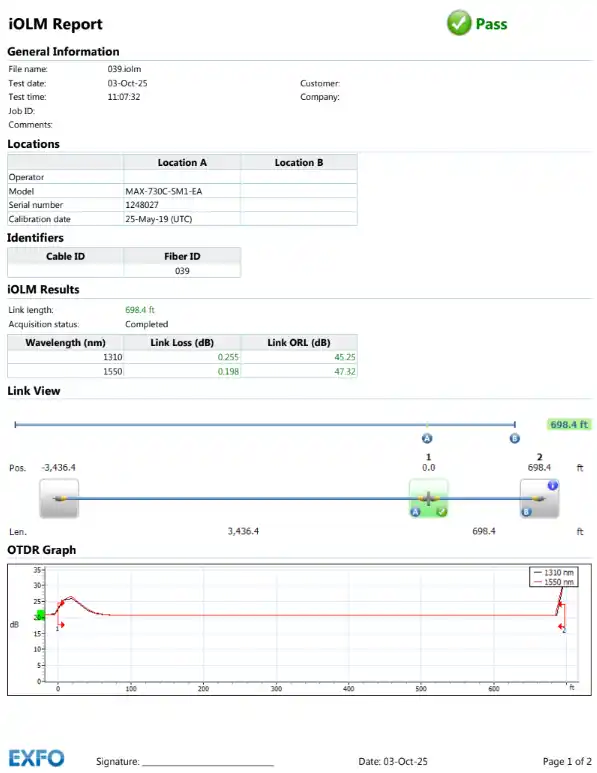
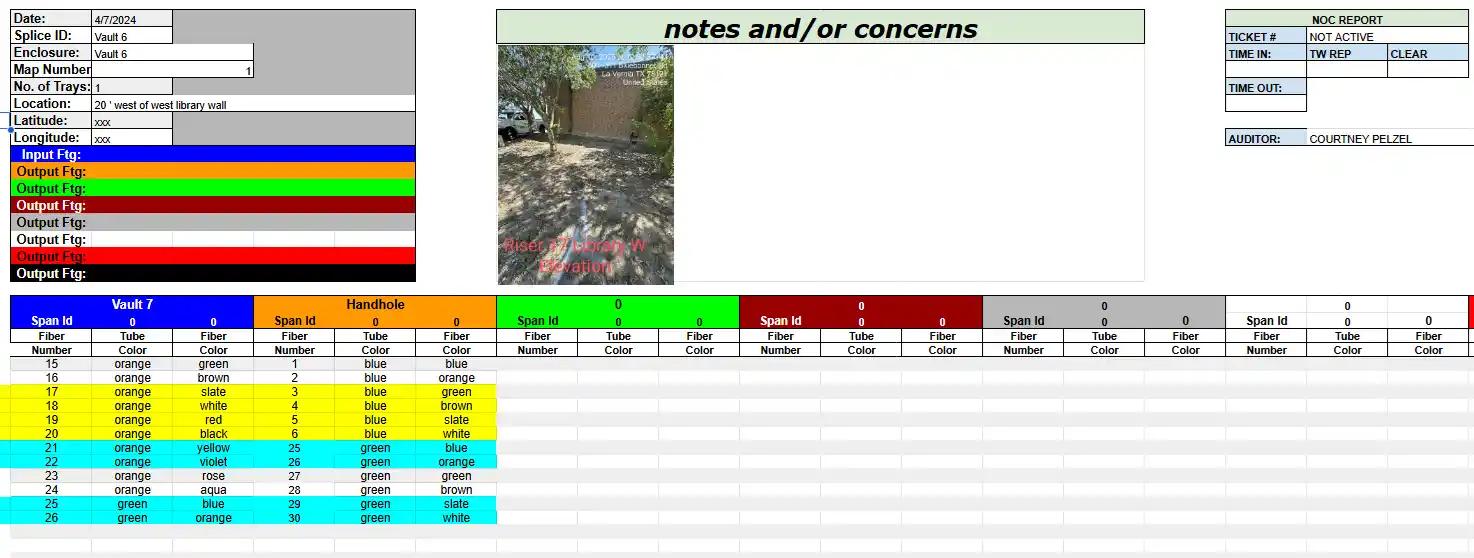
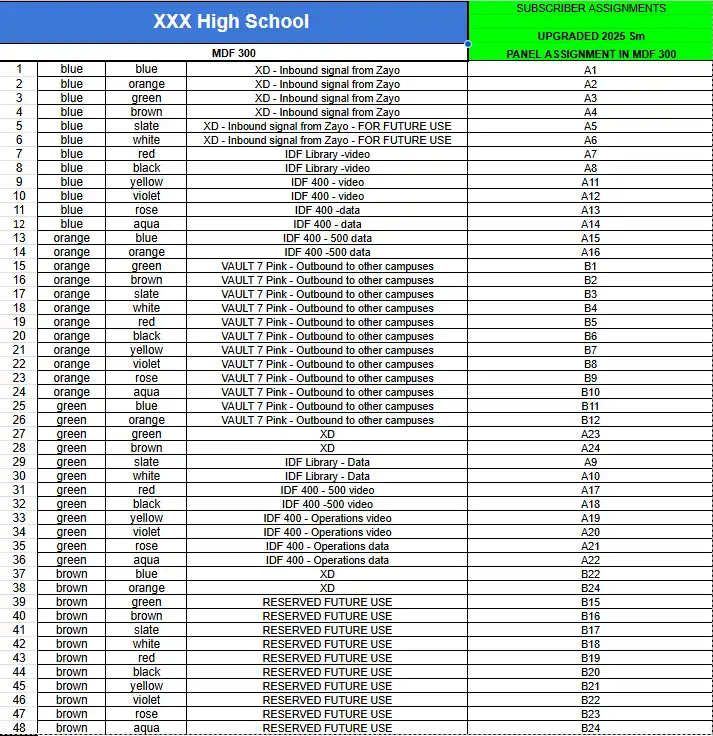
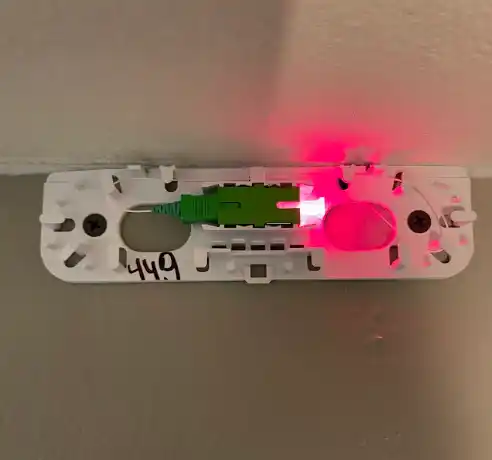
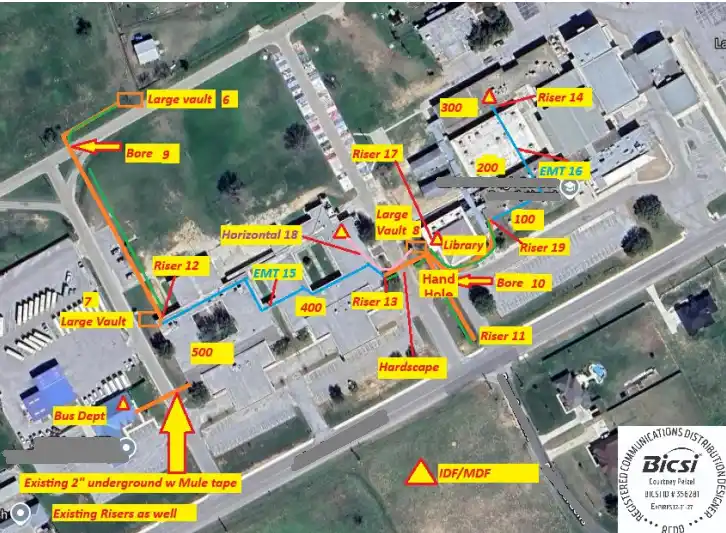
These photos are from our actual field work, not a stock library. The trace reports, the MOPs, the subscriber maps, this is what a finished fiber job looks like when it is done properly, and producing it takes time that belongs in the price.
Outside Plant, Briefly
When fiber goes outdoors and underground, a different set of costs appears. Exposed and buried fiber has to be protected and placed at the depths appropriate to where it lives, and the specifications differ between private property, right of way, aerial routes, and vaults. Placement methods range from trenching, boring, and plowing to micro-trenching, coyote holes, handhole placements, and plain old hand digging. Buried and routed fiber goes inside conduit, typically HDPE or PVC, and for truly mission critical links, the runs between campuses, or inside a hospital or healthcare facility, we place the fiber in its own dedicated protected pathway.
A note on who does what: we self-perform the design, project management, splicing, termination, testing, and documentation on outside plant work. The heavy civil placement scopes, aerial fiber placement, boring, micro-trenching, vault and handhole placements, underground HDPE placement, and jetting or blowing fiber, we subcontract to trusted partners we have worked with for years, under our management and our documentation standards. That said, we own thirty shovels, and if a job needs the last ten feet hand dug, we will dig it ourselves, as long as the locates are in. And on that subject: nothing goes in the ground without utility locates. Locates get scheduled before any digging scope starts, and that lead time belongs in the project schedule, not discovered during it. You get one accountable scope either way, and we are upfront about how it is built.
We are keeping this section short on purpose. Outside plant is a deep world with its own cost structure, and if your project involves it, that conversation happens on a site walk, not a web page. Contact us and we will walk it.
Brownfield Retrofit Is Our Sweet Spot
We do both greenfield new construction and brownfield retrofit, and we are highly proficient in brownfield retrofits. Honestly, we prefer it. Retrofitting fiber into existing commercial, industrial, and multifamily buildings means no lag waiting on the tail end of someone else’s construction schedule, faster completion, and less risk, which nets out better for our crew and for your budget. Occupied buildings, live environments, existing pathways with surprises in them, that is exactly the work our field experience is built for.
On the new construction side, we are selective: data center builds and high count fiber splicing are where we say yes. If your greenfield project is one of those, we should talk. If it is a retrofit, we definitely should talk.
Big Projects and the Project Speedometer
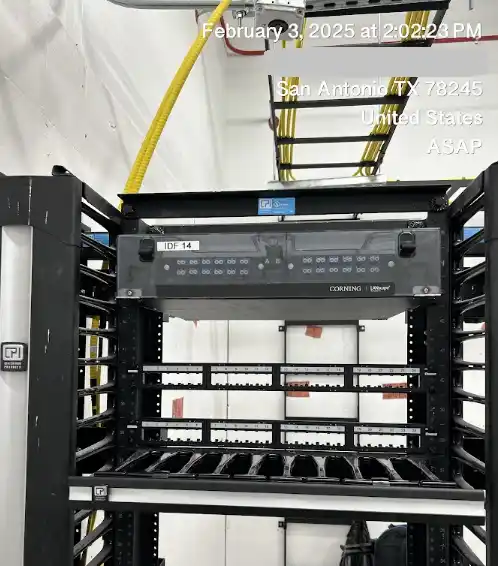
On large programs, where we work under a prime on hyperscale technology or energy infrastructure projects, project management becomes a cost line of its own, and it should be. For those jobs we run a proprietary progress tracker, a speedometer for the project, with daily tracking updates whenever a project manager is engaged. The PMs and construction managers we work for love it, because they can see exactly where the job stands without chasing anyone. It typically does not apply to the small commercial day jobs, and that is fine; the small jobs do not need a speedometer, they need a good crew and one clean afternoon. OSP pricing costs for fiber optic cost per ft in San Antonio typically come with an MSA attached and are characteristically ISP driven.
Reading a Cheap Fiber Bid: What Got Left Out
When a fiber quote comes in dramatically lower than the others, the money did not disappear, something else did. Here is what the cheap bid usually deletes:
- The testing. No bidirectional OTDR traces, maybe a flashlight-grade continuity check if you are lucky. You will find out whether the splices are good when something fails.
- The documentation. No as-built, no splice report, no MOP, no subscriber map. The next time it needs to be maintained starts from zero, on your dime.
- The pathway verification. Nobody rodded the conduit. The bid assumed the two pipes that look the same actually connect. Change order incoming.
- The strand count headroom. Sized for today with zero growth, so the next expansion means new cable instead of spare strands.
- The optics conversation. Nobody checked the SFP light budget against the link, and turn-up day becomes debugging day.
- The connector spec. UPC where APC was called for, or whatever was in the van. It works until it does not.
The companies that call us are often the ones who tried the cheap route first, or the providers who know fiber is a specialist trade and would rather bring in a crew that does it right the first time. Either way, we are glad to see you.
Design First: What the RCDD Stamp Means
We are very thorough in the design and preconstruction phase, and honestly, design is my favorite part of the project. Providing a full clarity scope, watching it click for stakeholders who started the meeting not understanding what we do, then carrying that design through splicing, placement, and the final turn up with every label in place, and handing the whole reviewed package to the project owner, that is the good stuff.
Here is what that thoroughness buys you: before I place my RCDD stamp on a design, I know ninety nine percent of what we are going to run into. The remaining one percent is the unforeseen, the thing behind the wall nobody could have known about, and that is the only place cost should ever have to adjust. A fiber project priced from a real design does not surprise you. A fiber project priced from a guess does nothing but.
Where We Work
Where We Install Fiber
ASAP Computer Services is headquartered in San Antonio. Our recurring fiber optic installation, fiber optic splicing, testing, and network infrastructure project footprint includes:
Greater San Antonio
including San Antonio, New Braunfels, Seguin, Boerne, and surrounding communities.
Central Texas
including San Marcos and projects throughout the broader San Antonio and Austin corridor.
South Texas
including
Victoria,
Corpus Christi,
and surrounding communities.
Texas Hill Country
including Boerne and other commercial and project locations west and northwest of San Antonio.
Fiber is also one of the services that can justify greater travel. Larger fiber installation, high-count splicing, ISP, data center, energy, and multi-site infrastructure projects may be supported elsewhere in Texas depending on project scope, schedule, crew requirements, and mobilization.
Projects outside our immediate San Antonio market may include a mobilization charge. When applicable, that cost is identified during quoting so travel is understood before work begins.
For splicing-focused projects across Texas, see our Texas fiber splicing services.
View all ASAP Computer Services service areas.
Ready for a fiber estimate based on your actual building, pathway, strand count, testing requirements, and project location? Call 210-497-1424 or contact us for a site assessment.
Ready for a fiber number based on your actual building instead of a guess? Call 210-497-1424 or contact us for a site walk. Related reading: our structured cabling cost guide and fiber optic splicing services.
Fiber Optic Installation Cost FAQ
How much does fiber optic installation cost in San Antonio?
It depends on the factors that actually drive fiber cost: strand count, jacket and armor type, singlemode versus multimode, connector and termination method, pathway condition, testing requirements, and the documentation package. An accurate fiber price requires seeing the pathway and the building, which is why we quote from a site walk, not a form.
What is the biggest cost driver on a fiber install?
Usually the pathway. If existing conduit is available and actually connects, the job gets simpler. If we are building pathway, or rodding conduit to discover what really connects to what, that work can outweigh the cost of the fiber itself. Strand count and armor type are the next biggest levers.
Do you provide testing and documentation with fiber installation?
Yes. Depending on the project, that includes light level testing, bidirectional OTDR traces merged into deliverable files, a method of procedure, a splice report, a subscriber assignment map, and the as-built your construction manager and future companies will rely on.
Can you handle small fiber jobs, like connecting two parts of a building?
Yes, and we enjoy them. Runs past copper’s 328 foot limit, demarc extensions, and single links between suites or wings are typically completed within a day, and the cost on those smaller projects is much easier to estimate.
Do you do fiber work for other ISPs and B2Bs?
Yes, and it is some of our favorite work. We support ISP and B2B companies that do not have splicing crews, fusion splicers, OTDR test equipment, or fiber documentation practices. Your client stays your client, and you get a fiber crew with the tooling and depth of field knowledge the work demands.
Do you do new construction fiber, or just retrofits?
Both, but we are experienced in brownfield retrofit and we prefer it: existing commercial, industrial, and multifamily buildings, occupied and live, with no waiting on another company’s schedule. On new construction we are selective, data center builds and high count fiber splicing are the greenfield projects we take.
Should we use singlemode or multimode fiber?
It depends on distance, the equipment on each end, and what already exists in the building. OS2 singlemode handles distance and backbone work, OM3 and newer multimode serves most in-building runs, and on utility and energy projects we still splice plenty of OM1. We match the fiber, the connectors, and the SFP light budget to the actual link during design.
Does project location affect fiber optic installation cost?
Yes. Distance from the crew, project duration, equipment transportation, fusion splicing and testing requirements, and other mobilization costs can affect the installed price. A larger regional fiber project can often absorb travel more efficiently because mobilization is distributed across more footage, strands, splices, buildings, or days of work.
